Furinkazan (風林火山): The Meaning Behind Takeda Shingen’s Samurai Strategy

Hi, I’m Yoshi, based in Tokyo. On this website, I introduce the spirit, wisdom, and beauty of Japan to people around the world through traditional kakemono scrolls.
In this article, I would like to share the true meaning of Furinkazan from a Japanese perspective — what these four characters mean to Japanese people, and why their spirit has endured for centuries.
The True Meaning of Furinkazan from a Japanese Perspective
Furinkazan (風林火山) is often translated outside Japan simply as “Wind, Forest, Fire, Mountain.” But in Japan, these four characters carry a much deeper meaning — one rooted in strategy, leadership, and the Samurai spirit.
These four forces of nature form Furinkazan, one of the most famous expressions in Japanese Samurai culture. The phrase is inseparably linked to Takeda Shingen (武田信玄), the legendary warlord of Japan’s Sengoku period. Yet Furinkazan has endured far beyond the battlefields of the 16th century. Today, it continues to appear in books, films, television dramas, games, and works of Japanese calligraphy.
For anyone drawn to Samurai history, Bushido, or Japanese culture, Furinkazan offers a powerful window into the strategic mind of one of Japan’s most legendary warlords.
What Does Furinkazan Mean?

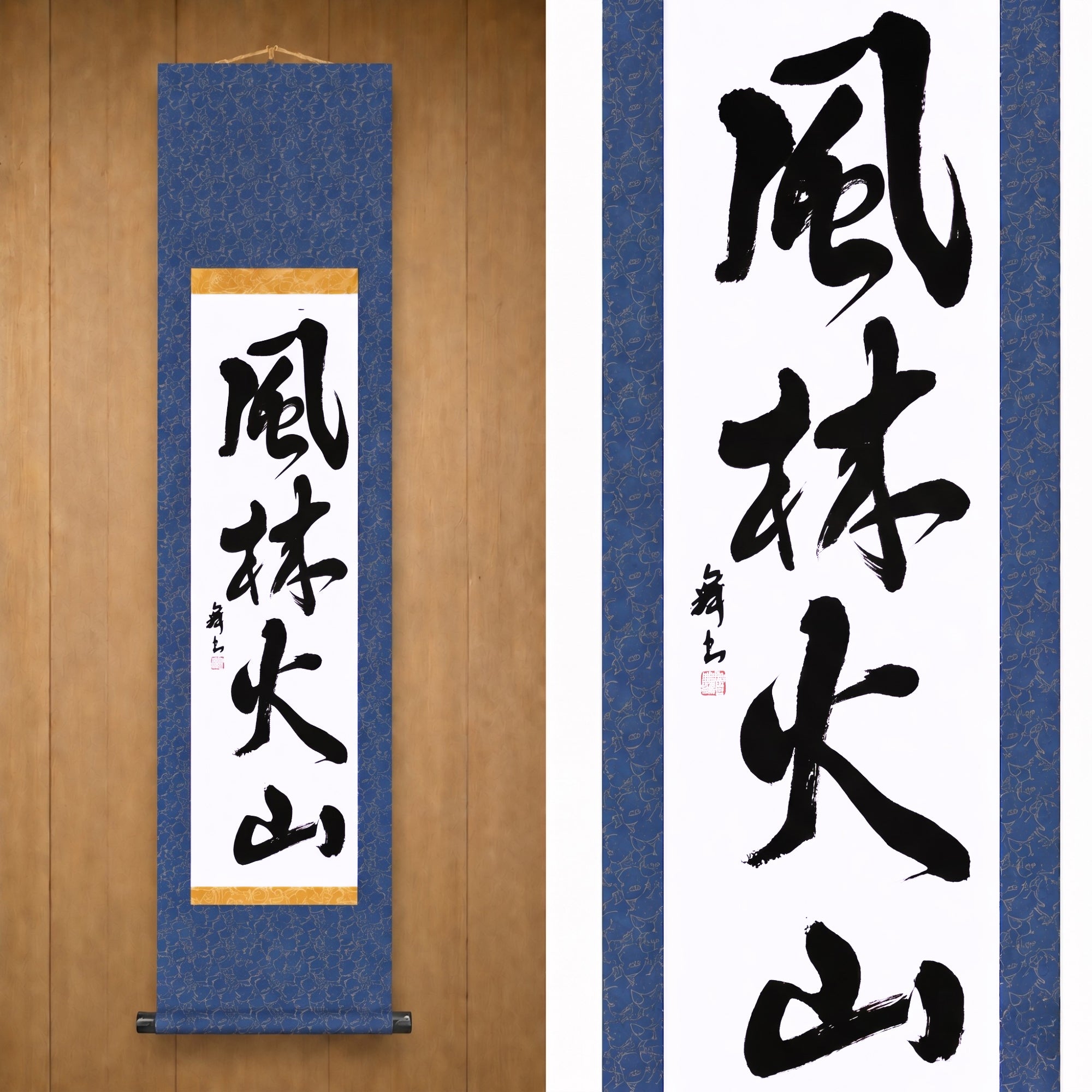
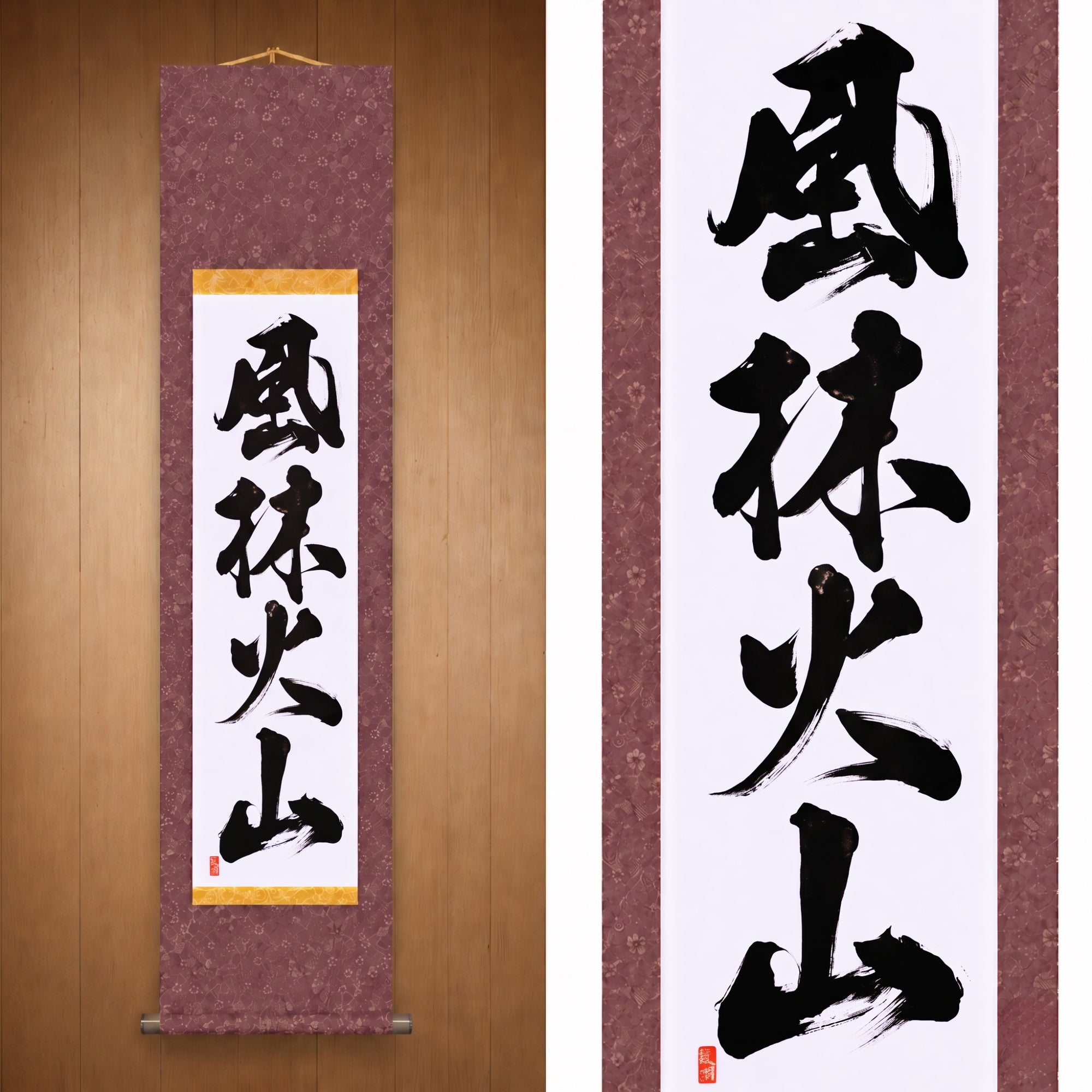
Furinkazan (風林火山) is written with four kanji:
風 (Fū): Swift as the Wind — Move quickly, seize opportunities, and adapt without hesitation.
林 (Rin): Silent as the Forest — Remain calm, disciplined, and composed, even in difficult situations.
火 (Ka): Fierce as Fire — Act with courage, determination, and overwhelming conviction when the moment comes.
山 (Zan): Immovable as the Mountain — Stand firm in your beliefs with patience, resilience, and inner strength.
Together, the four images form a complete strategy. Speed alone can become recklessness. Stillness alone can become hesitation. Power without control can become destructive, while firmness without adaptability can become stubbornness. Furinkazan is the wisdom to understand which quality the moment requires.
The Origin of Furinkazan

Although Furinkazan (風林火山) is now one of the most recognizable phrases associated with the Japanese Samurai, its roots lie in ancient China. The words are drawn from The Art of War, the classic military text by Sun Tzu.
The longer passage adopted for Takeda Shingen’s banner reads:
疾如風 — Swift as the Wind
徐如林 — Silent as the Forest
侵掠如火 — Fierce as Fire
不動如山 — Immovable as the Mountain
The familiar four-character form, 風林火山, brings together the central image from each line. This origin reveals why Furinkazan is more than a dramatic Samurai slogan. It is a philosophy of adaptation.
A wise leader does not respond to every challenge in the same way. There is a time to advance, a time to wait, a time to commit every resource, and a time to defend what must not be surrendered.
Takeda Shingen transformed this ancient strategy into one of the most enduring symbols of the Samurai era.
Takeda Shingen and the Banner of Furinkazan

Takeda Shingen (武田信玄, 1521–1573) was one of the most powerful daimyo of Japan’s Sengoku period, an age when rival Samurai clans fought for territory and influence. He ruled Kai Province, corresponding largely to present-day Yamanashi Prefecture, and became known as the Tiger of Kai.
His reputation rested not only on courage in battle, but also on military organization, political judgment, and the ability to inspire loyalty among his followers.
Shingen’s long rivalry with Uesugi Kenshin (上杉謙信) — the Dragon of Echigo — became one of the most celebrated rivalries in Japanese history. Their battles at Kawanakajima remain legendary, representing the clash of two exceptional commanders who came to embody the romance and intensity of the Sengoku age.
Takeda Shingen’s forces carried a banner bearing the lines that became known as Furinkazan. On the battlefield, banners helped soldiers identify and organize their forces, but they also expressed the identity and spirit of a clan.
Shingen’s banner declared how the Takeda army intended to fight: with speed, discipline, overwhelming force, and unshakable stability.
The words were not decoration. They were a statement of purpose.
The Warrior Who Defeated Tokugawa Ieyasu
Takeda Shingen’s reputation was built through action. At the Battle of Mikatagahara in 1573, his army dealt a devastating defeat to Tokugawa Ieyasu (徳川家康), the man who would later establish the Tokugawa shogunate and bring a long period of stability to Japan.
Ieyasu narrowly escaped and returned to Hamamatsu Castle. The battle became one of the most famous defeats of his life and one of the clearest demonstrations of the strength of the Takeda army.
International audiences may recognize Tokugawa Ieyasu as one of the principal historical inspirations for Yoshii Toranaga in the historical drama series Shōgun. Before he became the dominant ruler of Japan, however, Ieyasu had faced the full force of Takeda Shingen.
That history gives Furinkazan its weight. The words on Shingen’s banner became legendary because they were connected to an army whose speed, discipline, force, and stability were experienced by its enemies.
The Story of Sanbuichi Yusui

Takeda Shingen is remembered not only as a warrior, but also as a leader who understood organization, balance, and the needs of the people he governed.
In present-day Hokuto, Yamanashi Prefecture, there is a famous spring called Sanbuichi Yusui (三分一湧水). Its name means “water divided into three.” Three villages once competed for access to this precious water.
To end the conflict, Shingen created a system that divided the spring equally into three streams, allowing each village to receive its share. He did not solve the problem through force. He solved it through balance and wisdom.
The story reveals another side of Shingen’s leadership. Victory did not always mean defeating an enemy. It could also mean creating harmony among competing interests.
Furinkazan and the Spirit of Bushido

Furinkazan began as military strategy, while Bushido (武士道) grew into the broader tradition associated with the values and conduct of the Samurai. The qualities expressed by Furinkazan resonate deeply with that Samurai spirit.
Discipline makes swift action possible. Patience prevents fear and emotion from controlling judgment. Courage allows a person to act when the decisive moment arrives. Inner strength makes it possible to remain faithful to one’s purpose under pressure.
This is why Furinkazan continues to attract people who admire Bushido. It presents strength not as a single quality, but as mastery over many different states of mind.
True strength is not always loud. Sometimes it moves like wind. Sometimes it waits in silence. Sometimes it burns with absolute commitment. Sometimes it simply refuses to move.
Why Furinkazan Still Speaks to Us Today

The world of the Samurai has passed, but the choices represented by Furinkazan remain familiar. In work, we may need to act quickly before an opportunity disappears. In a difficult situation, we may need to remain silent long enough to understand what is really happening.
Once an important decision has been made, we may need the fire to carry it through. During uncertainty, we may need to stand like a mountain and remain true to our principles. Furinkazan does not tell us to be aggressive. It tells us to read the moment clearly and respond with the right kind of strength.
That message can speak to leaders, entrepreneurs, artists, athletes, and anyone facing change or adversity. It also has a natural connection to Japanese martial arts such as Karate, Judo, and Aikido, where timing, calm observation, decisive movement, balance, and an unshaken center are developed through years of practice.
Yet one does not need to practice martial arts to understand Furinkazan. Its wisdom belongs to anyone who has ever had to choose between moving and waiting, committing and enduring.
Furinkazan in Japanese Calligraphy
The four kanji of Furinkazan have a remarkable visual presence when written with brush and ink. The movement of the brush can suggest speed, stillness, intensity, and weight. Pressure, rhythm, spacing, and the natural flow of each stroke give the characters a life that printed letters cannot reproduce.
The personality and experience of the calligrapher become part of the work, making every handwritten piece unique. This makes Furinkazan especially suited to the traditional vertical form of a Japanese kakemono scroll, also called a kakejiku (掛軸) in Japan.
At Interior Calligraphy, we have expressed the spirit of Furinkazan through authentic Japanese calligraphy and traditional kakemono craftsmanship. Our aim is not simply to reproduce four famous kanji, but to give physical form to the philosophy behind them: clarity, discipline, courage, adaptability, and unwavering resolve.
Each Furinkazan kakemono is individually handcrafted in Japan by skilled artisans using traditional techniques. Natural variations in the brushwork ensure that every piece has its own character.
Displayed in a home, office, study, or dojo, the scroll creates a direct connection to one of Japan’s most enduring Samurai philosophies.
A Kakemono Scroll Is Your Silent Teacher

A kakemono scroll does not speak. But it is always there.
For centuries, Japanese people have displayed words of Budo, Zen teachings, and guiding principles for life in their homes and dojos. They were not displayed only for their beauty. They were placed where they could be seen every day — to help people remember the values by which they wished to live.
Courage. Discipline. Respect. Harmony. And the strength to remain true to oneself.
A kakemono scroll says nothing. Yet the words written upon it can quietly calm the mind and remind us of what truly matters. That is why we call a kakemono scroll your Silent Teacher.
Furinkazan asks us to recognize the nature of the moment. Should we move, wait, commit, or stand firm? The scroll offers no spoken answer. It simply remains in the room, quietly returning the question to us each day.
And whenever our direction becomes unclear, the four characters bring us back to their essential wisdom: wind reminds us to move swiftly, forest to remain calm, fire to act with complete commitment, and mountain to stand firm in what we believe.
More Than Art.
It’s Spirit.