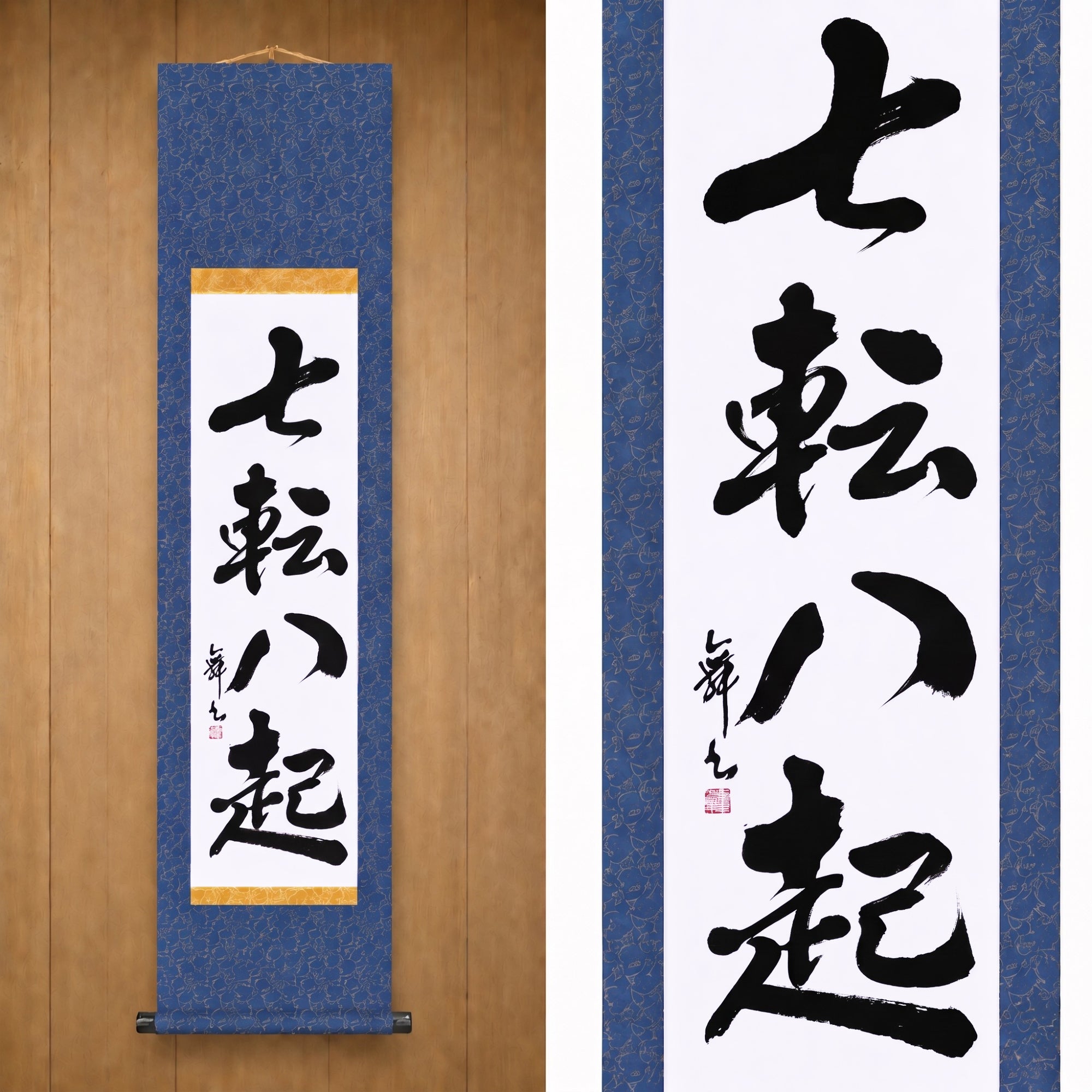
Shichiten Hakki (七転八起): The True Meaning of “Fall Seven Times, Rise Eight”

Hi, I’m Yoshi, based in Tokyo. On this website, I introduce the spirit, wisdom, and beauty of Japan to people around the world through traditional kakemono scrolls.
In this article, I would like to share the true meaning of Shichiten Hakki from a Japanese perspective: what the four kanji express, how the phrase developed in Japan, and why it remains relevant to martial artists and people facing challenges around the world.
The True Meaning of Shichiten Hakki from a Japanese Perspective
Shichiten Hakki (七転八起) is commonly translated as “Fall seven times, rise eight.” It describes the determination to recover from repeated failure, hardship, or disappointment and continue moving forward.
To Japanese people, the expression does not mean that a strong person never falls. Falling is treated as an ordinary part of life. Plans fail, confidence weakens, and circumstances change. The important question is what happens afterward.
The phrase therefore contains both realism and hope. It accepts that difficulty cannot always be avoided, while insisting that a setback does not have to become a permanent condition. Strength is found not in an unbroken record of success, but in the ability to restore one’s direction.
What Do the Four Kanji Mean?

Shichiten Hakki is a yojijukugo (四字熟語), a Japanese four-character expression. Yojijukugo can compress a complete idea into only four kanji, which is one reason they are often used as personal mottos and in Japanese calligraphy.
七 (Shichi) means seven — In this expression, it suggests repeated difficulties rather than a precise number.
転 (Ten) means to turn, roll, fall, or experience a reversal — It can describe a physical fall, but it also suggests failure or a sudden change in fortune.
八 (Hachi) means eight — Here it moves the expression beyond the number of falls and gives the phrase its sense of continuation.
起 (Ki) means to rise, stand up, recover, or begin — It is an active character: the person does not simply wait for circumstances to improve, but takes part in beginning again.
Together, the four characters create a complete movement. The first half acknowledges instability; the second half answers it with action.
Why Rise Eight Times After Falling Seven?

At first, the numbers appear illogical. If someone falls seven times, should that person not rise only seven times? The extra rise is precisely what gives the expression its emotional force.
Numbers in Japanese proverbs and idioms are often symbolic. Seven can indicate many occasions or many kinds of difficulty. Eight has long carried positive associations in Japan because the kanji 八 widens toward the bottom. This shape is called suehirogari (末広がり), suggesting expansion, prosperity, and a future that opens outward.
Within Shichiten Hakki, eight can therefore be understood as the possibility that remains after repeated setbacks. The will to recover is represented as one step greater than the forces that caused the fall.
Several popular stories attempt to explain the exact arithmetic, but no single historical interpretation has been proven. For an international reader, the safest and most useful understanding is symbolic: defeat may be repeated, but recovery must have the final word.
The History of Shichiten Hakki in Japan
Shichiten Hakki does not have one clearly identified founder, nor is there a single classical text universally accepted as its origin.
Japanese dictionaries record an expression using the same image of falling seven times and rising eight in a work published around 1680, during the late 17th century. The compact four-character form 七転八起 is documented in Japanese writing from 1885–1886, in the late 19th century. It later became widely established as an expression of perseverance and recovery.
The idea is sometimes connected with Buddhism because Buddhist thought addresses suffering, impermanence, and the possibility of renewal. Those themes are compatible with Shichiten Hakki, but it would be misleading to claim that the phrase comes directly from one specific Buddhist scripture or teaching.
Its history is better understood as the gradual development of a familiar image within Japanese language and culture. That absence of a single founder also gives the phrase a universal quality. It does not belong only to one warrior, religious school, or historical event.
The Daruma: A Japanese Symbol of Recovery

In Japan, the spirit of Shichiten Hakki is often represented by the Daruma (達磨), the round doll modeled after Bodhidharma, the monk traditionally associated with the beginnings of Zen Buddhism.
A Daruma is weighted at the bottom so that it returns upright when pushed over. Its form turns an abstract idea into something immediately visible: pressure may disturb its position, but it does not remain on the ground.
Daruma dolls are also connected with goal setting. A person commonly paints one eye when making a wish or committing to a goal, then completes the second eye when the goal is achieved. The unfinished face keeps the intention visible during the period of effort.
The custom does not promise that determination alone will guarantee success. Instead, it recognizes that meaningful goals usually require time, correction, and repeated attempts. For foreign visitors, the Daruma is sometimes treated simply as a lucky object. In Japan, however, it can also represent personal responsibility: good fortune is welcomed, but the individual must continue the work.
Perseverance Is Not the Same as Stubbornness
Shichiten Hakki is often reduced to the English phrase “Never give up.” That translation is useful, but incomplete. If perseverance means repeating the same mistake without reflection, it can become stubbornness rather than strength.
To stand after a fall is not necessarily to return unchanged. A setback may show that the method was ineffective, the timing was wrong, or important knowledge was missing. Recovery can require a different plan, advice from another person, or the humility to begin again at a more basic level.
This distinction is important in Japanese training culture. Serious practice involves repetition, but repetition is not mindless. Each attempt should reveal a small difference: balance, timing, posture, concentration, or judgment. The purpose is not simply to endure more pain. It is to transform experience into greater skill.
Seen in this way, Shichiten Hakki combines persistence with adaptability. The person keeps the purpose but may change the path.
Shichiten Hakki and Japanese Martial Arts

The meaning of Shichiten Hakki is especially clear in Budo, the Japanese martial arts. Progress in a dojo is built through mistakes, correction, and the willingness to train again after frustration.
In Judo, one of the first skills we learn is ukemi, the art of falling safely. Before a practitioner can throw confidently, he or she must learn not to fear being thrown. Every fall provides information about posture, balance, distance, and timing. As someone who practices Judo, I feel that this is one of the most honest expressions of Shichiten Hakki: falling is not separate from training; it is part of training.
In Karate, students repeat kihon and kata for years. The outward sequence may look the same, but the practitioner continues refining stance, breathing, speed, focus, and control. Improvement is often too small to see in a single day, yet it becomes visible over time.
In Aikido, progress requires sensitivity, relaxed movement, and awareness of one’s partner. Trying to force a technique can make it less effective. Failure becomes a signal to adjust the body and remove unnecessary tension.
Kendo and other Japanese martial arts also treat defeat as a source of study. A lost match can expose a weakness in technique or state of mind that victory might have hidden. Shichiten Hakki is not itself an ancient rule of Bushido, but its values strongly resonate with Budo: humility before the lesson, discipline in practice, and courage after defeat.
Shugyo, Craftsmanship, and Long Practice

The philosophy also connects with the Japanese idea of shugyo (修行), sustained training through which skill and character are developed together. The word is used in religious and martial contexts, but it can also describe a long period of serious dedication to an art or craft.
Traditional calligraphers, potters, woodworkers, sword polishers, and other artisans do not expect mastery to appear immediately. A brushstroke cannot simply be corrected after it has been placed on paper. Clay can collapse. Lacquer work can be damaged by dust or humidity. The maker learns through results that cannot always be hidden or reversed.
This does not mean that Japanese craftsmanship is based on suffering for its own sake. The essential value is attention. Each unsuccessful result becomes evidence. Over many years, the craftsperson develops judgment that cannot be gained from theory alone.
For international readers accustomed to measuring progress through quick results, Shichiten Hakki offers another standard: the quality of one’s return to the work may matter more than the speed of the first success.
Shichiten Hakki in Japanese Calligraphy
The four kanji of Shichiten Hakki have a powerful vertical rhythm when written with brush and ink. The first two characters carry the movement of falling and reversal. The final two turn the composition toward recovery and renewed action.
Calligraphy records the movement of the body. Speed, pressure, breathing, spacing, and the release of the brush all become visible in the finished work. A forceful style may emphasize determination, while a calmer style may express patience, dignity, and inner stability.
This makes Shichiten Hakki especially meaningful as a traditional kakemono scroll, also called a kakejiku (掛軸) in Japan. Displayed in a home, office, study, or dojo, the words become part of the space and can be encountered every day.
At Interior Calligraphy, each Shichiten Hakki kakemono is individually written by a Japanese calligrapher and handcrafted into a hanging scroll by skilled artisans in Japan. Natural variations in the brushwork ensure that every piece has its own character.
The purpose is not simply to decorate a wall. It is to give physical form to a principle that may be needed when confidence weakens or progress becomes difficult.
A Kakemono Scroll Is Your Silent Teacher

A kakemono scroll does not speak. But it is always there.
For centuries, Japanese people have displayed words of Budo, Zen teachings, and guiding principles for life in their homes and dojos. They were not displayed only for their beauty. They were placed where they could be seen every day, quietly reminding people of the values by which they wished to live.
A written principle cannot make a decision for us. It can, however, interrupt discouragement and return the mind to what matters. That is why we call a kakemono scroll your Silent Teacher.
Shichiten Hakki asks no one to live without failure. Its four characters offer a simpler and more human challenge: when the fall comes, learn what it can teach, recover your direction, and stand once more.
Fall seven times. Rise eight.
More Than Art.
It’s Spirit.